
Resources
FAQ
The answers to the most frequently asked questions about wine on tap and ECOFASS systems, to understand how it works before getting equipped.
FAQ
Frequently asked questions
Find answers to the most common questions about storing, filling, dispensing and maintaining Ecofass drums and pouches.
Empty drums: storage temperature between 0 and 25°C. Do not store empty drums under pressure; depressurize immediately on return. Full drums: storage temperature <25°C. Do not store drums in the sun or roll them.
Pouches should be stored in their packaging, in a clean, dry place. Pouch storage temperature: > 10°C.
No, the pouches are single-use.
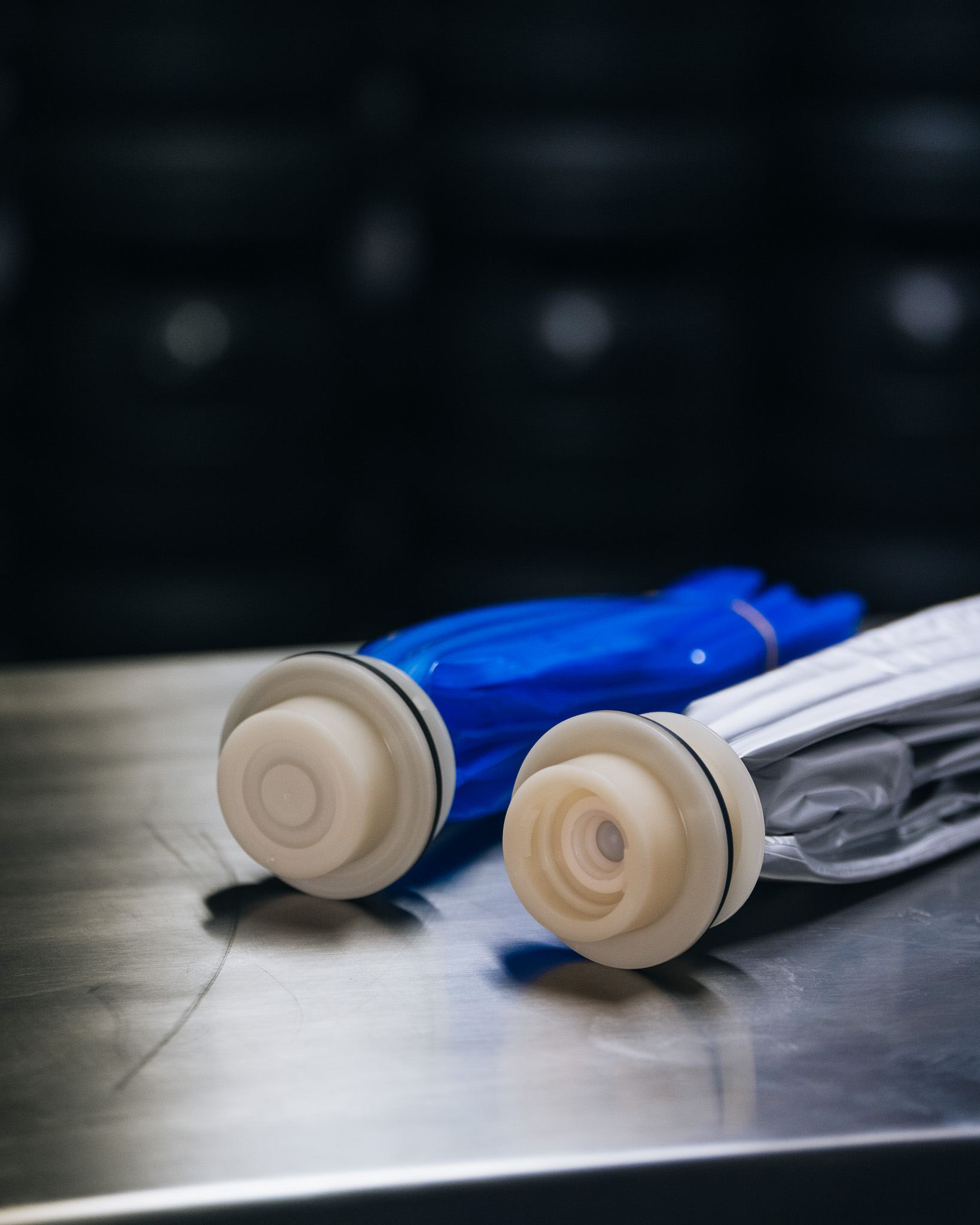
The pouch is a multi-layer complex that offers several advantages. Its oxygen barrier allows longer, optimal storage of your wine and dispensing without the gas ever coming into contact with the wine. What’s more, the pouch also protects the drum, so there’s no need to clean it.
Ecofass drums can be filled with still or sparkling wines.
No, Ecofass is suitable for standard catering (CHR) installations and works with “A” or “S” type dispensing heads.
Maximum operating pressure is 3 bar. The drum is fitted with a safety valve set at 4 or 6 bar depending on the model.
All drums have a diameter of 310 mm. The 10L drum is 358 mm high and weighs 6.2 kg empty, the 20L drum is 508 mm high and weighs 5.2 kg empty, the 25L drum is 582 mm high and weighs 5.8 kg empty, and the 30L drum is 662 mm high and weighs 6.2 kg empty.
Yes.
Empty drums: on an 80x120x215 pallet, 8 drums per row, i.e. 40 drums in 10L, 32 in 20L, 24 in 25L and 24 in 30L. On a 100x120x215 pallet, 11 drums per row, i.e. 55 drums in 10L, 44 in 20L, 33 in 25L and 33 in 30L. Full drums: on an 80×120 pallet, 8 drums per row, i.e. 24 drums in 10L, 16 in 20L, 16 in 25L and 16 in 30L. On a 100×120 pallet, 11 drums per row, i.e. 33 drums in 10L, 22 in 20L, 22 in 25L and 22 in 30L. For full drums, it is possible to stack pallets, with a maximum height of two pallets of two rows of drums.
No, each drum must be used with the same size pouch. Each drum/pouch must not be underfilled.
Drum life is estimated at 10 years, based on 5 rotations per drum per year. Reminder: do not store an empty drum under pressure, for safety reasons and to ensure proper use of the drum. It is important to depressurize the drum as soon as it is returned to the estate. See the depressurization procedure in the user manual.
The drum is guaranteed for 1 year.
The safety valve is a wearing part. It can be replaced. Please contact us for the valve replacement procedure.
Yes, 100% made in France.
You will need an “A” or “S” type filling head, a clamping bell, a ratchet or torque wrench, a pump (when filling still wine) and a compressor. It is also possible to use a turner; please consult us.
No, filling must take place with the drum inverted to ensure optimum pouch deployment during filling. See our user manual.
Yes, when filling a still wine.
The average filling time is between 2 min and 5 min.
Yes, whatever the type of wine, filling must be carried out with constant back pressure throughout filling. We recommend a back pressure of 0.8 bar for a pressure of between 1.5 and 2 bar at the pump or isobarometric tank outlet.
Yes, whatever the type of wine, a back pressure of 2.5 bar must be applied once the pouch is full.
At the end of filling, the filling head pressure gauge drops to 0 bar. At this point, immediately cut off the wine/liquid inlet: the drum is full. You can check the volume by weighing your drum.
Please consult your manufacturer.
Dispensing is done under neutral gas. Thanks to the barrier pouch, the dispensing gas never comes into contact with the wine.
Yes, the drums fit standard CHR dispensing heads.
Always depressurize the drum before unscrewing the nut to remove the pouch: engage the filling head, open the air release valve and let the air out, then open the wine/liquid inlet valve to also depressurize the inside of the pouch, and finally unscrew the nut safely. If you use a dispensing head, remember to remove the non-return valve.
It is possible that the seals on the head of the pouch are stuck. In this case, operate the filling head several times on the drum head. If depressurization is still not possible, inject a slight back pressure to loosen the seals, then open the air release valve and depressurize the drum before safely loosening the nut. Reminder: do not store a drum under pressure; the drum must be depressurized as soon as it is returned to the estate.
No, once the pouch has been emptied, depressurize the drum and remove the pouch.
The drums are 100% recyclable. The pouches are multi-layered complexes that are currently difficult to reprocess. They are classified as Solid Recovered Fuels (SRF) and can be used to produce heat and/or electricity, reducing, among other things, dependence on fossil fuels (gas, coal, oil) and the amount of waste sent to landfill. A pouch recycling solution is being studied with our partner.
The 20L, 25L and 30L sizes are available in 3 different ring colors (yellow, black or red). You can personalize the drums with a sticker, using stencils and spray paint. We can offer you a solution for screen-printing the ring. Please do not hesitate to contact us.