
Resources

Practical guides

Four practical guides to understanding wine on tap: how it works, its benefits and what it actually changes at service.

How to grow wine by the glass?

You grow wine by the glass around a simple principle: a flexible liner, placed inside a reusable keg, protects the wine from air from the first glass to the last glass served. The gas compresses the liner without ever coming into contact with the wine, which you serve on tap like a beer on tap.

If you are new to the format, setup follows three steps: you receive the keg filled by the winegrower, you connect it to a tap line, then you serve by the glass on demand. The remaining wine keeps its qualities for up to 120 days after the keg is opened, which gives you time to adjust your wine-by-the-glass list without fear of waste.

Growing wine by the glass is also a logistics choice for your establishment: an ECOFASS keg replaces the equivalent of 26 75cl bottles, or 19 kg of glass saved, with less handling in the dining room and in storage.

How to reduce losses?

Your losses of wine by the glass almost always come from the same place: an opened bottle that oxidizes before it is finished. With an ECOFASS system, you protect the wine from air at all times thanks to the flexible liner that retracts as service proceeds — it is never in contact with oxygen, unlike a bottle reopened several times.

In practical terms, this means that a glass you serve several weeks after the keg is opened can stay close, in quality, to the first glass served, within the stated conservation limit, up to 120 days. You serve by the glass, on demand, without having to estimate your daily consumption or sacrifice a bottle for a single customer.

The reduction in losses also comes from the format itself: a reusable keg reduces the glass you lose bottle by bottle, and service on tap would allow on the order of 17% of time saved compared with uncorking and traditional service.

How to preserve an open wine?

You know it well: an open wine deteriorates on contact with air — that is oxidation, and it is what every conservation system seeks to slow down. A bottle you recork keeps losing freshness day by day, because the air that has already entered stays in contact with the wine.

The principle of an ECOFASS keg is different: the wine is enclosed in a flexible liner that empties and retracts as service proceeds, without ever letting air in. The gas acts only between the liner and the wall of the keg, never on the wine itself.

The wine thus keeps its qualities for up to 120 days after the keg is opened, against just a few days for an opened bottle. You can therefore offer wine by the glass with confidence, without having to use up an entire container in a single service.

Bottled wine or wine on tap?

The question is not which is the better wine: with an ECOFASS system, it is exactly the same wine that the winegrower puts into the liner. The real difference plays out after opening, at the moment of service.

A bottle of wine, once uncorked, oxidizes within a few days and must be finished or thrown away. A keg on tap keeps the wine protected from air until the last glass served, up to 120 days after opening, thanks to the flexible liner that retracts as service proceeds.

The format also changes your logistics: a keg replaces the equivalent of 26 75cl bottles, or 19 kg of glass saved. The keg empties to the last drop, with no loss. If you serve by the glass regularly, the choice comes down less to wine quality than to what each format lets you preserve, and serve, after opening.

User manual: filling and safety

Safety reminders

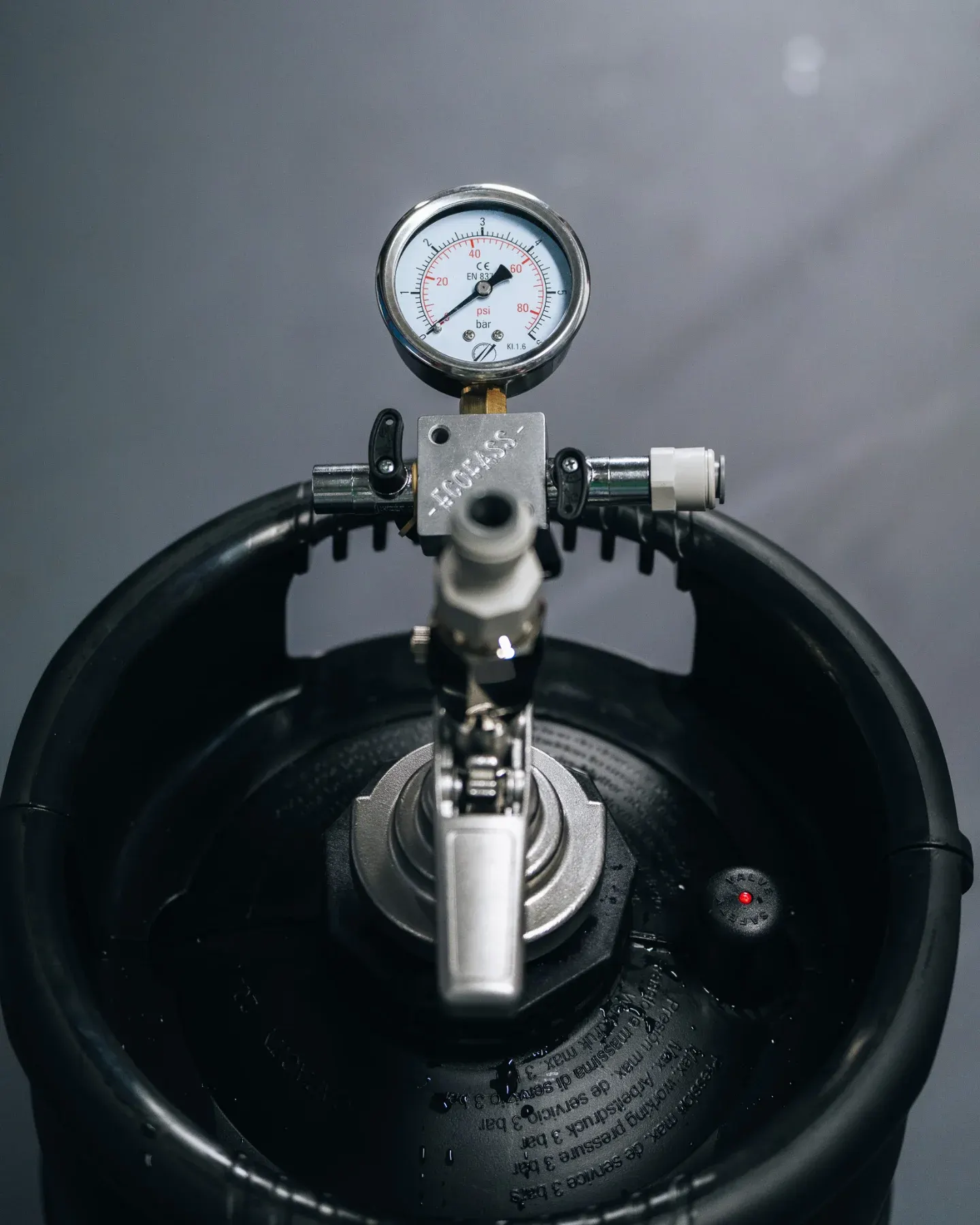
The Ecofass keg is a pressurised product: handle it with care. Do not throw it or roll it.

  • Maximum operating pressure: 3 bar.
  • Never store an empty keg under pressure — depressurise it as soon as it returns.
  • Recommended storage temperature for the keg: between 0° and 25°C; pouches: in a clean, dry place, above 10°C.
  • Filling and dispensing heads must be in excellent condition to guarantee a perfect seal on connection.

A returned keg is under pressure

Imperative: depressurise the keg before disassembly by engaging the filling head, letting the gas escape on the air side (air or CO2 — this volume never touches the wine). If the head seal sticks and makes the keg look unpressurised, operate the handle several times; if it still sticks, apply slight pressure on the air side to release the seal, then vent the pressure.

Inserting the pouch into the keg

  • Check that the seal between the head and the keg neck is correctly positioned.
  • Remove the elastic bands and insert the pouch carefully, without piercing it on the inner edge of the neck.
  • Tighten the retaining nut to 50 Nm using the tightening bell, then spray a disinfectant on the head.
  • A poorly tightened nut = air leak at the keg head = loss of counter-pressure.

Filling in five steps — keg upside down, imperatively

  • 1. Remove residual air from the pouch: apply 0.8 bar between keg and pouch via the gas inlet, open then close the liquid-side valve while keeping the counter-pressure.
  • 2. Prepare the filling: connect the disinfected head to the pump (maximum pump outlet pressure 2.5 bar) and fill the hose until no air bubbles remain.
  • 3. Fill the keg head-down, keeping a constant counter-pressure of 0.8 bar via the air-side vent (general value, adjust to your conditions).
  • 4. Recommended filling time is between 2 and 5 minutes; never put 20 L into a 30 L keg. When the counter-pressure drops to 0 bar, close the product inlet valve.
  • 5. Finish: close the air-side vent, apply a 2.5 bar counter-pressure (except for forced carbonation), turn the keg upright, rinse thoroughly with water, dry the head with filtered air, disinfect and apply a tamper-evident cap.

Removing the liner, on video.

Download the full user manual (PDF)